
Pasta heating technology
We offer a wide range of the modern heating elements based on the new composite pastes technology.
Our modern heaters are successfully used in food, packaging industry, utilities sector, housing constructions and much more.
The paste is a mixture of powders with different properties, dispersed in the organic binder. By changing the ratio of ingredients and compositions it is possible to obtain a set of composite materials with the necessary parameters.
Heat treatment is performed for all proposed pastes in air in the temperature range of 650-850 ˚C.
One of the significant advantages of our pastes is the absence of expensive, deficient precious metals and their compounds. Due to this, the cost of our pastes is quite competitive.
Types of the pastes
Features of pastes:
- Adhesion to metal and ceramic bases is not less than 50 kg/cm²;
- The minimum width of lines is 250 microns;
- The minimum distance between the lines is 300 microns;
Manufactured by innovative nanotechnology our heaters has a base thickness 1-8mm and any geometric shape. The resistive paste with any possible configuration are placed on the substrate by printing method. The detailed heater strucrure is shown on the image below. The electrical circuit resistance is securely isolated from the substrate and the environment.
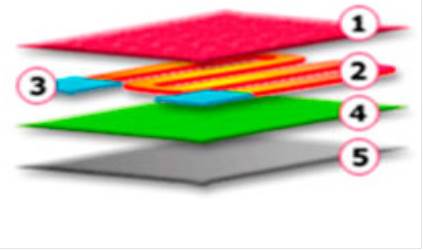 |
1. Protective layer 2. Resistor element 3. Contacts 4.Glass-ceramic layer 5. Steel plate |
This technology allows by the screen printing method, followed by heating, to put functional (dielectric, conductive, or resistive) composite pastes in the form of films with thickness of 20-40 microns to surfaces of various materials: metals, ceramics, etc. Our heaters are a "sandwich" of 2 or more layers.
